In Dutch:
THE ENGLISH LIBERATORS OF EERBEEK AND LOENEN.
Eerbeek and Loenen were liberated by the English, while the surrounding places were liberated by the Canadians.
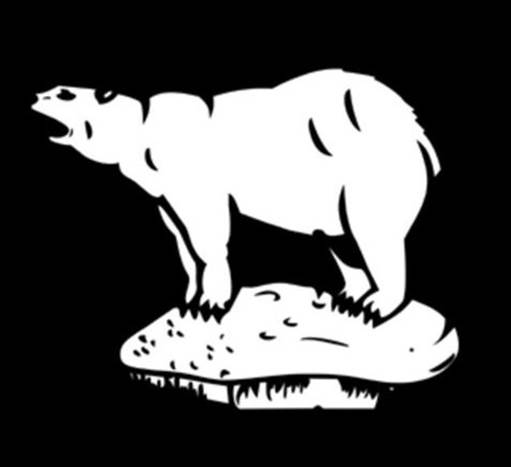
Who are the Polar Bears?
Great Britain has a rich military history, with famous and honorable names derived from the regions where the soldiers came from.
In 1907 a division was founded in Yorkshire: The British 49th infantry Division, of the West Riding-Division. This division was composed of various combat and support units. In the First World War this division fought in France.
In the Second World War the division was given its first war task:
Participating in missions in Norway and then as a defense army in Iceland. There they received the addition "Polar Bear Division" and the insignia of the Polar Bear.
In 1942, "The Reconnaissance Corps" (Reconnaissance Corps) was founded in England with the popular name: Recce's.
In English the popular name Recce's is used.
One of the regiments was assigned to the Polar Bears. The men came from all over the United Kingdom and received the same training as a commando.
These Polar Bear Recce's received a small white rose, the Rose of York, on the sleeve emblem that all Recce's wear.
After fighting in France and Belgium, they ended up near Rozendaal in the Netherlands, eventually staying stuck in the Betuwe for the time being. They have bad memories of this, because large parts were flooded by the Germans, so that they camped on a kind of island in the cold of 1944-1945. On March 15, 1945, the Polar Bears were placed under the command of the 1st Canadian Army Corps.
MARCH/APRIL 1945: THE PLANS
The high command had been given two Canadian army corps, which came from Italy where the battle was over. A plan was then drawn up, which looked something like this:
- "OPERATION DESTROYER". The second Canadian army corps will go to the right of the Rhine into the Liemers and head towards Germany
- "OPERATION QUICK ANGER". The first Canadian army corps must advance east of the IJssel and cross the IJssel between Doesburg and Deventer "OPERATION CANNONSHOTH".
- "OPERATION DUTCH CLEANSER". The first Canadian army corps is given the following task: They want to lay a smoke screen between Randwijk and Huissen to cross the Rhine and then advance in a pincer movement to the IJsselmeer.
They wanted to avoid having to fight (with heavy equipment) in the West of the Netherlands, because of the marshy ground and the dense population density of the West of the Netherlands. The following tasks were assigned to the Polar Bears: First clear the Overbetuwe of Germans and then capture the city of Arnhem.
THE EXECUTION
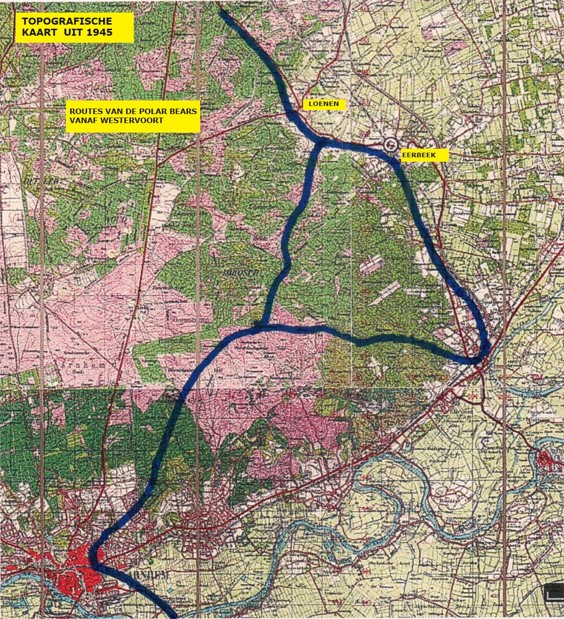
The Polar Bears crossed the Rhine at Emmerik and Huissen and then the IJssel at Westervoort. This operation went well and the English advanced to Arnhem and after a few days of fierce fighting they had the city in their hands. It was a strange sensation for the English to have to fight in a ghost town, because except for the German soldiers the entire city was deserted.
In the meantime the main force of the 2nd Canadian Army Corps had started their mission and had crossed the IJssel at Wilp and reached the east side of the Apeldoorn canal on 16 April. They wanted to start shelling Apeldoorn on 17 April and then cross the canal.
The fact that Apeldoorn was spared from the violence of war is partly due to the cleansing of the Recce’s (Polar Bears) in the entire area.
The Canadians from Voorst and Klarenbeek were therefore able to lay a Baily bridge over the canal in Loenen unhindered and then enter Loenen after a few skirmishes, in order to take Apeldoorn the next day.
HOW DID IT GO IN EERBEEK AND LOENEN?
The C-Squadron entered Eerbeek via the Imbos, which was taken without a fight. In Loenen, there was a fight. On the Eerbeekseweg near the Van Gijtenbeek butcher shop, the Germans had set up a fortification. They fired mortar fire at the approaching English.
Three grenades landed near café Plant. Two exploded, one of which destroyed the front of Plant's house. But the most tragic thing was that the neighbour across the street, Mrs Bredenoord, was fatally hit by a grenade splinter.
The shelling had no consequences for the advancing English. They had just passed the point.
A German fired a Panzerfaust at an English armoured car of the "Humber Mk. IV" type. The Humber caught fire, but the crew was able to jump out. During the fire, the ammunition exploded, fatally hitting the daughter of the Bredenoord family. She was a niece of Mrs Bredenoord who had been fatally hit a few moments earlier.
On the other side of the canal, the Germans made one-man holes on 15 April and set up a machine gun there. Liberation was expected from the east, where shots had been heard from the directions of Voorst and Brummen for several days.
Everyone thought that a fight would take place during the night. Residents spent the night in shelters.
But the Germans had disappeared.
It became a sunny day and reconnaissance planes flew in the air all morning. Around half past one, Canadian brenngun carriers arrived from the Zilven bridge. There was still some shooting.
From the Voorsterweg bridge, they headed towards the village and a few German soldiers were captured and taken away.
That day, the Recce captured 143 Germans. Later that day, the English withdrew again. They usually operated from a fixed army camp. The Canadians remained bivouacked with their tanks in a kraal formation at the place where they arrived. After the English had liberated Loenen, Loenen was filled with Canadians.
Later that day, the Canadians placed a Baily bridge at the Loenen bridge. The crossing of the canal (OPERATION BODEN) had apparently been planned earlier, because the Germans also expected the crossing of the canal here.
The Polar Bears were also involved in liberation actions in various places in the Netherlands. For example, it was the Recce's who brought the entire Northwest Veluwe under control on 19 April. They also entered the city of Utrecht and they were the first to enter Amsterdam with two Humbers and four brenngun carriers.
There too they were received by a wildly enthusiastic population. But because there were too few of them and the war was not yet over at that time, they were quickly called back. There were still too many Germans in the city, some of whom were still very aggressive. The number of Englishmen was too small to protect the population against this.
It took another forty years before the city council of Amsterdam admitted that it was the English and not the Canadians who were the first to enter the city. After the liberation of the Netherlands, they served in Germany with the occupying army for some time.
In England the Division was disbanded in 1947.
After the visit of the English to Loenen, a warm mutual bond continued to exist. There were visits to Loenen in 1985, 1990, 1995 and 2000.
In 1995 the liberators visited both Loenen and Eerbeek and liberation benches were unveiled in both places.
HE LAST TWENTY-FIVE YEARS
Delegates from Loenen have often attended the veterans' reunion, which is held annually in London.
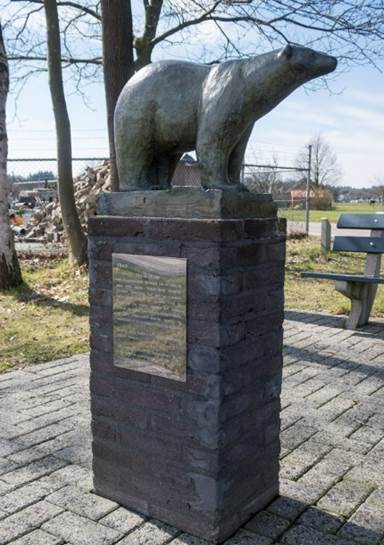
In June 1998, the Division in Croxhall England received its own "Polar Bear" monument. The names Eerbeek and Loenen are mentioned on the monument. During the unveiling on 7 June 1998, Henk Witteveen came up with the idea to create a similar monument (in the form of a polar bear) somewhere in Eerbeek-Loenen in the year 2000. Paul Sanders, the chairman of the memorial committee, immediately adopted this idea and with the help of volunteers from Eerbeek and Loenen this was a great success. Initially, it was thought that the planned traffic roundabout would be placed at the intersection of Eerbeekse-, Loenense- and Harderwijkerweg, but given that the roundabout would take years to be built, the monument (a polar bear) has now been given a place on the border of Loenen and Eerbeek. The unveiling took place on Saturday 6 May 2000 in the presence of the Recce's.
In 2002, on the occasion of the fact that it was 60 years ago that The Reconnaissance Corps was founded, a reunion was held of all the Recce's who served in the various divisions.
The annual reunion of the Polar Bear Recce's was cancelled from that moment on. Probably due to the advanced age of the veterans. There were still individual contacts (with children of...).
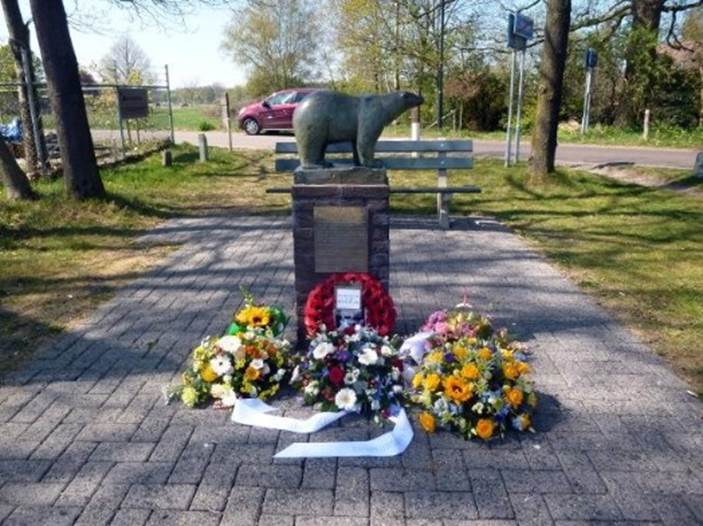
ANNUAL COMMEMORATION AROUND 16 APRIL
The RKBS C.v.Leeuwenschool from Eerbeek adopted the Polar Bear Monument in 2009. The pupils from group 8 of the school organise the commemoration around 16 April every year, with a fixed programme, during which they immediately hand over the script for the coming year to their successors. In the presence of their parents, the pupils from group 7 (their successors), the mayor of Brummen, Stichting 45 from Apeldoorn, guests and the committee members, there is an annual ceremony with speeches, poems, stories, the national anthems and music from the years 1940-1950.
Text: Henk Witteveen
Text recommendations 2003: Paul J. Sanders
Sources consulted:
General-Major B.Koning: "Bevrijding van Nederland 1944-1945".
Peter A.Veldheer: "The Battle of the Veluwe".
1945. The liberation of the Veluwe by British and Canadian troops in April of the last year of the war.
Patrick Delaforce: "The Polar Bears". Montys left flank.
From Normandy to the relief of Holland with the 49th Division.

www.kinderen-in-brummen.nl